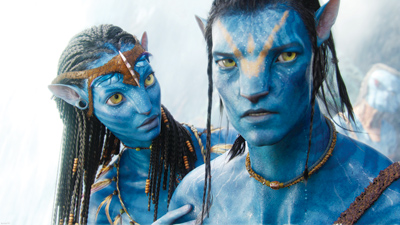
How To Write For 3D ........By Sherri Sheridan New articles are now posted on MyFlik.com. Avatar is the new Star Wars for this generation of digital filmmakers. The visual fourth wall has just been shattered inviting the audience to now be in the film they are watching during a 3D IMAX type viewing experience. As a filmmaker and writer, you now have to consider things like Z depth, and how your story can literally reach out and grab the audience from the screen in full 3D glory – every scene. New Article coming soon in the big 2010 April NAB edition of Student Filmmakers Magazine! 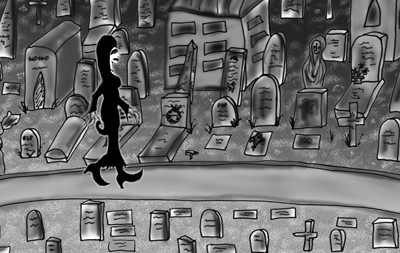
The Cheapest Feature? Modern 2D ...By Sherri Sheridan What is the cheapest and easiest type of feature film for one person or a small team to make these days? I would say a highly stylized 2D animated Southpark looking cartoon. Why? Because no one can say it does not look right or real. New Article coming soon in the big NAB edition of Student Filmmakers Magazine! Longer versions of each new article will be posted on MyFlik.com soon with videos. New How To Articles For Student Filmmakers Magazine 
A new series of articles by Sherri Sheridan on story for digital filmmaking will be appearing in Student Filmmakers Magazine. This section is getting an update soon. For more information on articles please check MyFlik.com. Low Budget Sc-Fi Epic By Barbara Gibson “I’m desktop cinema incarnate,’” quips Graham Robertson, describing his role as writer, director, producer, editor and production designer of the campy feature film “Able Edwards” — whose executive producers include Steven Soderbergh, Jay Hart and David Mazer. 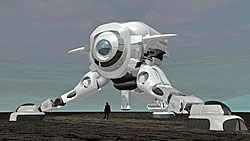
Available Talent: Art Students helped create the models. Robertson drew on tabloid rumors to write the “Able Edwards,” the story of scientists who clone a cryogenically-frozen entertainment mogul in an attempt to revive the glory days of an economically-challenged space colony.
Even though the story takes place 200 years from now, the look is pure 40s and “Citizen Kane.”
Only it’s mostly virtual.
Robertson shot the film entirely in mini-DV against a small green screen in the corner of a warehouse, but composited the live action with digital sets on the Mac — ably demonstrating that it’s possible to create a film of epic proportions on an ultra-low budget.
$23 in Late Fees
Robertson expresses a certain pride that he and coproducer Scott Bailey managed to shoot the entire feature in 15 days on a budget of $30,000.
“We had no sets,” says Robertson who, ironically, has dressed sets for hundred-million-dollar films such as “Pirates of the Carribean,” “Swordfish” and a new sci-fi epic, “Serenity.” Bailey was lead set dresser for “L.A. Confidential,” “Pleasantville,” “Fight Club” and “Pirates of the Caribbean.”
Lacking a large bankroll, Robertson hung out at the downtown branch of the Los Angeles County library, sorting through walls of architecture books for images he could scan and manipulate in Photoshop.
“Twenty-three dollars in late fees and a month later,” Robertson says, “we had our sets.”
A Windup Rocket
Once he had scanned images from different books, Robertson used Photoshop to create original images for the film’s retro-futuristic environment.
“We shot the film in a little tiny room, but I wanted it to have a great, grand feeling and I knew we could fake a lot of that with virtual sets.”
First, he converted the scanned images to black and white — not only to establish the retro sci-fi atmosphere, but also to eliminate potential problems of color consistency and spill from the green screen.
Then he assembled bits and pieces of the scanned images — in one case, a jungle, ancient ruins, a restroom sign and a vintage windup toy rocket — to create a series of digital sets.
“We shot the film in a little tiny room,” Robertson says, “but I wanted it to have a great, grand feeling and I knew we could fake a lot of that with virtual sets.”
And a little help from his friends.
Modeling the World
When the script called for 3D models of a spaceship and space station, Robertson turned to graduates of Pasadena’s Art Center.
Bailey’s brother created the model for the Fantastic Wonderland amusement park. An architect friend in Korea designed the virtual atrium. A friend of a friend created the film’s animated fireball sequence.Available Talent. Art students helped create the models.
“They all thought the film was cool and interesting,” Robertson says, “and they wanted to contribute to it, so it worked out. When everyone was done creating their models, they just emailed the 3D files to me over iChat. It’s a really handy way to transfer big files.”
Closer to home, Robertson’s girlfriend, who worked as a technical director on “South Park” and teaches Maya at the Art Center, rendered the raw 3D files in QuickTime so they could be imported into Final Cut Pro.
And whenever the script called for crowd scenes, Robertson says, “we called everyone we knew.”
Cartoon Storyboard
With the digital sets in place, Robertson built storyboards for each of the film’s 700 scenes.
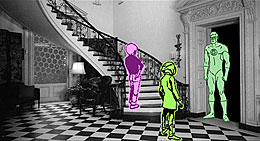
Rather than spend money on traditional hand-drawn illustrations to identify the main poses of a shot, Robertson pasted Cartoon Network animation models of Batman, Superman and Wonder Woman onto the digital scenes.
“I had a PowerBook,” he explains, “so later on, during the shoot, I could flip through the storyboard when I wanted to show the actors what building or object they would be standing in front of or behind.
“In one scene, the storyboard shows actors walking down a hallway. But when we shoot, they’re really just walking in place against the greenscreen. We had a lot of fun with that technique. Old films used a lot of rear projection — Jimmy Stewart driving down a road that’s fading away behind him, for instance — and ‘Able Edwards’ is all rear projection.”
40 Hours of Mini-DV
Robertson used a Canon XL1 to shoot 40 hours of mini-DV tape in weekend shoots over the summer.
“I had this 12-inch Lone Ranger doll and I put him in front of a green cloth. Then, in Final Cut Pro, I edited the shot so the Lone Ranger was standing in front of a building.”
“We thought about shooting on Beta or High Def,” he says, “but we didn’t have the money. If we hadn’t had the mini-DV or the Mac, the film wouldn’t have gotten done.”
After each shoot, Robertson imported the digital video into Final Cut Pro, logged the content, set the in/out points and rendered them as QuickTime files.
The Urban Lone Ranger
“Working with Final Cut is like having all the tools you need in front of you and you just get to play with them. It’s pretty amazing,” Robertson says.
“For instance, Final Cut has a good keying program, which is a great way to prep. I’d throw the footage onto the Mac, pull out the green and get a general idea of how the scene was going to look.
“When I first started developing the ‘Able Edwards’ scenario,” Robertson says, “keying was probably the first tool I used. I had this 12-inch Lone Ranger doll and I put him in front of a green cloth. Then, in Final Cut Pro, I edited the shot so the Lone Ranger was standing in front of a building.
“It looked great. I knew we could do ‘Able Edwards.’”Paper Props. To create the digital sets, Robertson combined elements of different photographs he’d scanned from library books.
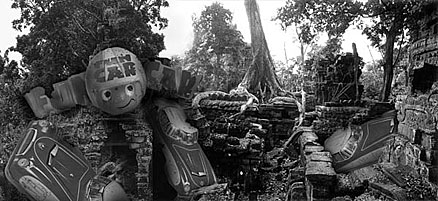
Paper Props. To create the digital sets. Robertson combined elements of different photographs he'd scanned from library books.
Sandwiching Scenes
When Bailey and Robertson were satisfied with the edits, Robertson began working on the final cut as if he were creating an animated film, combining layers of digital backgrounds with 3D renderings and live footage.
He began by importing the greenscreen QuickTime files into Combustion. Then he replaced the green screen with the digital backgrounds and, when the scene called for them, foreground components such as a pile of rubble or an android on a gurney.
When he had finished the composites, Robertson brought the files back into Final Cut Pro and assembled the finished film.
When the film was complete, he stored the entire movie — 19 gigabytes in a DV compression format — on a 40GB iPod and carried it to a processor to burn the DVD master.
Accessible Moviemaking
“When I first told people about the project,” Robertson muses, “they’d say ‘Whoa, that’s a lot of work.’ But it’s not really work. When you’re enjoying yourself and learning and solving problems, it’s a good time.
“Francis Ford Coppola,” he adds, “once said there would come a day when some little fat girl from Ohio would borrow her dad’s camcorder and become the next Mozart of moviemaking.
We like to think that we are that little fat girl.”
(To watch the trailer on Apple's website go here) September 10, 2004 |